Bunker-Busting TACO
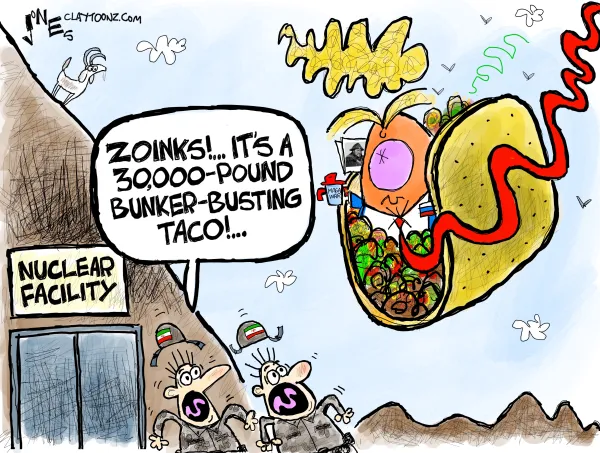
Bombing Iran Is Part of the USA’s Repetition Compulsion for War War War

Twenty years ago, one day in June 2005, I talked with an Iranian man who was selling underwear at the Tehran Grand Bazaar. People all over the world want peace, he said, but governments won’t let them have it.
I thought of that conversation on Saturday night after the U.S. government attacked nuclear sites in Iran. For many days before that, polling clearly showed that most Americans did not want the United States to attack Iran. “Only 16 percent of Americans think the U.S. military should get involved in the conflict between Israel and Iran,” YouGov pollsters reported, while “60 percent say it should not and 24 percent are not sure.”
From Iran to Everywhere, We Live in Terror of the “Peaceful Atom Apocalypse”

Donald Trump has opened the military door to an atomic apocalypse.
But it’s likeliest to come through the “Peaceful Atom Window.”
The 400+ atomic power reactors (94 in the US) now operating worldwide are all sitting ducks for low-tech attack.
Iran or any other nation or terror group, with or without a nuclear warhead, can blow apart any commercial reactor with a single drone.
The resulting apocalypse can be spreading as you read this.
Commercial atomic power makes nuclear warheads ridiculously obsolete. The Trump/Netanyahu attacks on Iran’s alleged bomb factories ae marginal at most to today’s atomic reality.
Once blown apart by a drone, earthquake, tsunami, human error, equipment failure or simple sabotage, any atomic reactor can irradiate a continent, an ocean… the planet as a whole.
All commercial reactors operating in the world today are without comprehensive private insurance.
They are sitting naked ducks…absurdly vulnerable to a simple low-level attack from a single combatant with a drone, mortar, instrument of sabotage.
They deported Emerson
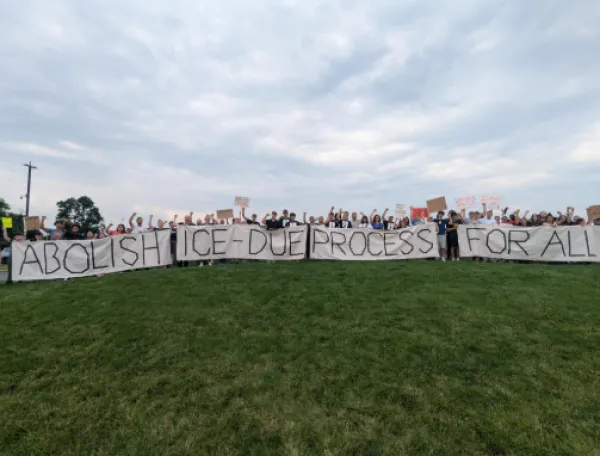
Following is a statement from Lynn Tramonte, Executive Director of the Ohio Immigrant Alliance, after the deportation of Cincinnati teenager Emerson Colindres.
"They did it. The Trump administration deported Emerson Colindres. What kind of cold, callous heart do you have to have deport a young man like him, at the start of his future? Like his whole family, Emerson was on a path to a U visa. He lived most of his life here. His teachers love him, his teammates, his coaches. This didn't have to happen. The federal government could have made a different choice; they could have let him stay.
Scuttling International Humanitarian Assistance

Since the return of Donald Trump to the White House, he and his Republican allies have worked to destroy the U.S. government’s overseas humanitarian aid programs.
This action flies in the face of the U.S. government’s lengthy record of humanitarian assistance to people of other nations whose lives had been blighted by war, poverty, and illness. From the Marshall Plan to rebuild war-devastated Europe, to Senator George McGovern’s Food for Peace project to feed the hungry, to massive international public health campaigns to eradicate global diseases, U.S. aid programs have played an important role in alleviating human suffering around the world.
Saifulal-Din Azam: The Pakistani Air Force pilot who shot down 4 Israeli aircrafts

During the 1967 Six-Day War, Pakistan did not just pray, and it didn't just issue shallow political statements, but it did what only a decent country would do. It sent its pilots to the frontline and to fly in the Arab skies and while some countries were watching from afar and talking about "neutrality" like what they are doing now with Iran, Pakistan, despite the distance, was closer to the heart of the battle.
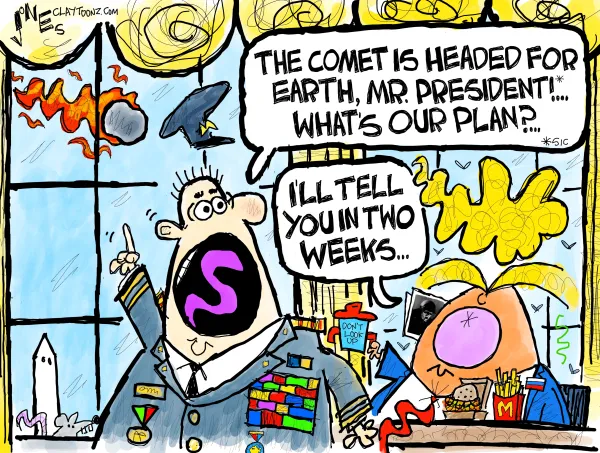
Two Weeks Notice
Sumud: The Unyielding Heart of the Palestinian Cause in Gaza

The profound and unrelenting struggles endured by Palestinians should, by any rational expectation, have irrevocably concluded the Palestinian cause. Yet, the struggle for freedom in Palestine is at its zenith. How is one to explain this?
Attempts aimed at the erasure of Palestine, the Palestinian people, and their cause go back well over a century. This encompasses the historical and ongoing impacts of the Balfour Declaration and the subsequent Mandate period, which ushered in an era of extreme violence, systemic suppression, and the imposition of harsh emergency regulations.
The devastating Nakba - the catastrophic destruction of the Palestinian homeland - was followed by the enactment of new emergency laws and the widespread dispersal of several Palestinian generations into the Shattat (diaspora).
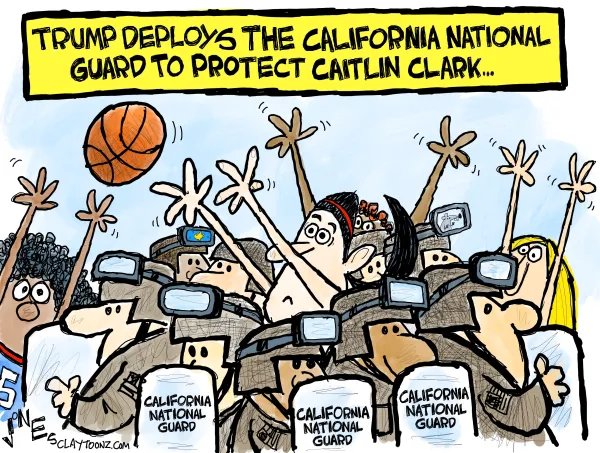
Isn't it Ironic?