
Opinion

“Excuse me, occasionally it might be a good idea to be honest about American foreign policy.”
I don’t think I’ve heard that much honesty from a mainstream-party presidential candidate in virtually half a century. And suddenly this race begins to matter in a way that seems like . . . oh my God, a return of democracy? Suddenly I don’t feel utterly marginalized as a voter, as an American, left with nothing but cynical despair as I wait to learn which “lesser evil” the Dems will serve up for me as a candidate.
The words are those of Bernie Sanders, of course, standing up to the red-baiting the moderators and some of the other candidates were slinging at him during the latest debate, trying their best to bring him down.
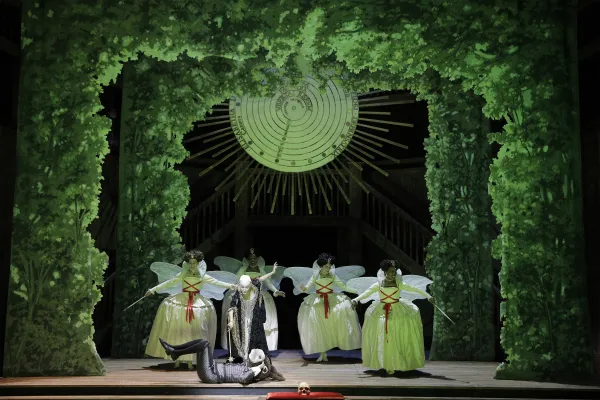
Move over Broadway’s recently opened musical adaptation of the 1960s’ wife-swapping movie Bob and Carol and Ted and Alice, which has nothing on LA Opera’s premiere of Gaetano Donizetti’s opera Roberto Devereux about the 1600s’ kinky hi-jinks of Bob and Liz and Sara and Duke. To be more specific, I’m referring to the ménage-a-quatre (to coin a phrase?) between the titular character, Roberto Devereux (aka the Earl of Essex), Queen Elizabeth, Sara (the Duchess of Nottingham) and the Duke of Nottingham in Elizabethan England.
Donizetti’s tragedia lirica (tragic opera) with Salvadore Cammarano’s libretto, first produced in 1837 at Naples, is loosely based on at least one play and a publication about actual historical personages. This is one of Donizetti’s works depicting England’s House of Tudor, which include the Italian composer’s operas about Anne Boleyn (King Henry VIII’s doomed wife is alluded to in Roberto as she gave birth to Elizabeth) and Mary, Queen of Scots.

The last time the Freep wrote about Reynoldsburg’s Tierna Oxenreider, in 2017, the then 12-year-old was being hailed as one of the world’s best fencers in her age group. That summer she won the US Junior Championship for those under 12. The following year she placed 3rd at the US Junior Olympics for all age groups (under 20).
The fencing prodigy, who at the age of four insisted to her parents “I want to do a sword sport,” could see gold in her future. How can you doubt her Olympic dreams when an epiphany to pick up a weapon so to compete strikes you before kindergarten?
But no one said life was fair, and there’s never a clear and easy path to the top of the medal stand. Last year she injured her back while competing in Germany. Then the injury was aggravated when she was a passenger in a car rear-ended by a texting driver.

George Lakey’s new book is called How We Win: A Guide to Nonviolent Direct Action Campaigning. On its cover is a drawing of a hand holding up two fingers in what is more often considered a peace sign than a victory sign, but I suppose it is meant as both.
Perhaps nobody is better qualified to write such a book, and it’s hard to imagine one better written. Lakey co-wrote a similar book in the 1960s and has been studying the matter ever since. He doesn’t just draw lessons from the Civil Rights movement, wasn’t just there at the time, but was applying lessons from earlier actions to training activists at the time. His new book provides — at least for me — new insights even about the very most familiar and often discussed nonviolent actions of the past (as well as lots of new rarely discussed actions). I’d recommend that anyone interested in a better world get this book immediately.

Enhanced Medicare for All — that wild scheme that Michael Bloomberg calls “untried” because it’s only been tested for decades in virtually every wealthy nation on earth — would cost $450 billion a year less than the current U.S. system. In the usual propaganda terms (in which you multiply by ten and then — if asked — admit that you’re talking about ten years) that’s a savings of $4.5 trillion! Let’s be honest and call it $450 billion a year.
The health coverage debate has gone on for the past century in the United States, during which numerous other studies have reached similar conclusions. The massive savings that awaits us according to these studies, does not include the potential healthcare savings of greater, more reliable preventive care, or of the reduced stress of guaranteed coverage, or the economic benefits of investing in Medicare For All.
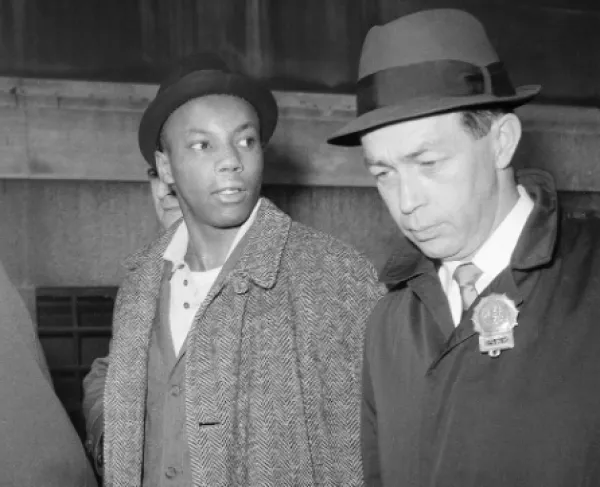
Fifty-five years ago on February 21, civil rights activist Malcolm X was shot on stage at the Audubon Ballroom in New York City. Three men were quickly arrested for the murder. Two of those men — including our client, Muhammad Abdul Aziz (then known as Norman 3X Butler) — have always maintained their innocence.
"Who Killed Malcom X?", a new six-part documentary on Netflix, seeks to answer the question: Did two innocent men spend decades in prison for crimes they did not commit?

One of the top ways to celebrate Black History Month - and the movie going experience in general - is to attend the Los Angeles-based 28th Annual Pan African Film & Arts Festival. PAFF focuses on Black-themed films, ranging from studio pictures to indie productions, with works from Hollywood, the USA, Mother Africa, the Caribbean, Melanesia (the Black South Pacific Islands, such as Fiji), Australia (this fest remembers that Down Under’s indigenous people, the Aborigines, are also Black) and beyond. The features, documentaries, shorts, animated pictures, etc., from Africa and the Black Diaspora provide movie fans an opportunity to see independent and international films in the world’s entertainment capital that Angelenos may otherwise never get an opportunity to view. This yearly cultural gemstone includes workshops and panels presented by the PAFF Institute, plus an ArtFest centered at Cinemark’s Baldwin Hills Crenshaw Plaza and the adjoining shopping complex.

[NOTE: This review may contain plot spoilers for those unfamiliar with this 2,600 myth.]
LA Opera’s world premiere of composer Matthew Aucoin and librettist Sarah Ruhl’s sublime Eurydice is an optically and aurally stunning reinterpretation of the ancient Greek myth about Orpheus (Canadian baritone Joshua Hopkins) and the title character (depicted by Angeleno soprano Danielle de Niese and at the performance I experienced, by Rhode Island soprano Erica Petrocelli). Like Romeo and Juliet - consider that Shakespeare’s tragedy inspired the beloved stage and screen adaptations of West Side Story in 1957 and 1961, with a new iteration opening on Broadway this week, with a Steven Spielberg movie remake waiting in the wings - there have been many versions of this immortal romance derived from Grecian mythology.
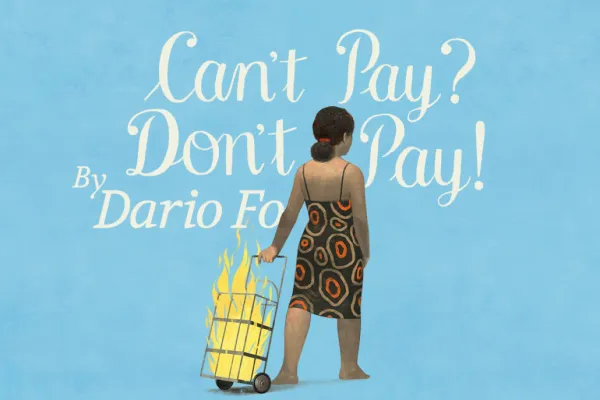
The Actors’ Gang’s production of Can’t Pay? Don’t Pay! is a synergy of Hollywood slapstick a la the Three Stooges and American TV show s like I Love Lucy, The Honeymooners and Roseanne crossed by and infused with the anarchist and socialist politics of Mikhail Bakunin, Pierre-Joseph Proudhon and Karl Marx. This merry madcap Marxist mash-up puts the “commie” into sitcom. To paraphrase the Stooges’ Curley: “Moe! Larry! Che!”

[NOTE: For those unfamiliar with Frida Kahlo’s life, this review may contain plot spoilers.]
If Howard Zinn penned “People’s Histories” and Oliver Stone filmed “Untold Histories,” Latinx playwright Odalys Nanin’s modus operandi is to write (or rewrite?) allegedly biographical plays about famous women revealing their same sex affairs. I previously saw Nanin’s stage exposes purporting that Greta Garbo and Marilyn Monroe indulged in Sappho hanky-panky. Some may regard this as a breakthrough, disclosing the hitherto concealed, unvarnished lesbian truth. Some may react with puritanical disbelief and outrage that their beloved sex goddess has been thusly tarred and defamed. Still others could respond with a collective yawn, musing “that’s so 20th century” and “so what? Who Cares?” Take your pick.