
Opinion
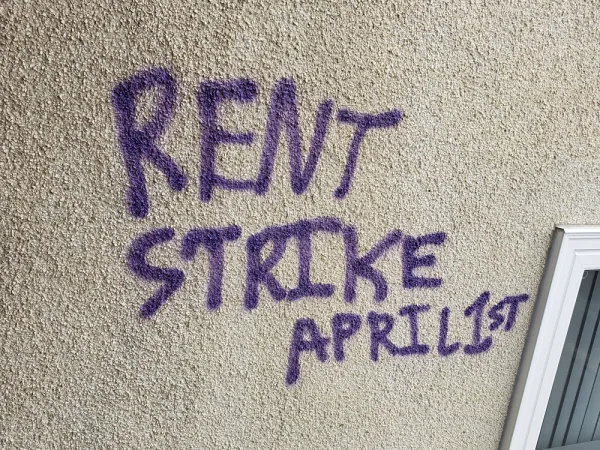
Who’s worse than an OSU campus slumlord?
Any OSU campus slumlord demanding rent be paid April 1st, and also threatening to raise rents because they fear a large number of their tenants will be unable to pay.
A “Rent Strike” for the forthcoming months is looming at home and abroad.
Rightfully so, our government has sent us home and shuttered many places of employment. The state’s unemployment website keeps crashing on many applicants.
In Columbus, where so many jobs barely pay the bills month-to-month, many local tenants simply won’t have the funds to pay their rent. A disaster in the making – as if we need to tell you what the skipping record keeps repeating.
Even if a surge of homelessness is staring our community in the face, Columbus tenants posting on the Rent Strike Ohio Facebook pageare saying many local landlords have made it abundantly clear in letters: Rent will be due on April 1st or face eviction when courts re-open.

There’s no question that the recent spread of coronavirus has changed the world as we know it for the rest of our lives. As of this writing, there’s still no way to know the full devastation, destruction and death toll that will ultimately result from this pandemic, but the impact will certainly be long term. So, as humans are ought to do in times of peril, we must look towards any semblance of a silver lining this crisis presents. Once the virus is contained and we can collectively move on, policies that have embraced both progressive and libertarian solutions to the pandemic could potentially become permanent, in addition to any positive impacts on the environment that have resulted from curbing our economic activity. When this ends, hopefully politics (and the planet!) can change for the better in the decades to come.

Federal Judge in Southern District of New York Finds Detention Under Unsafe Conditions was Unconstitutional; Holds ICE Accountable for Failure to Consider Release for People Most at Risk.

In a recent article I reported existing evidence on the way in which COVID-19 is being used to implement, but also divert attention from, initiatives being taken by the global elite to consolidate and expand its power in significant ways, and perhaps to make the final drive to take total control of global society. See ‘Observing Elites Manipulate Our Fear: COVID-19, Propaganda and Knowledge’.
Professionals who work on the front lines of protecting the rights of people held in Ohio detention centers, jails, and prisons are calling for swift action to prevent COVID-19 outbreaks.
“U.S. immigration detention facilities are the perfect arrangement to cause an explosion of COVID-19 cases,” said Dr. Laura Chambers-Kersh, a family physician based in Beavercreek. Detainees live in “cramped, overcrowded quarters with limited access to basic preventive measures like soap and water, hand sanitizer, and the ability to social distance,” she said in a March 24 press conference.

When you hit the doors, and despite the fact that I’m writing this during the coronavirus stay-in-place days, we will be hitting doors again in the by and by, then you have to count. In order to count, you will need a system to rate the responses that you are hearing on the doors once you put fist to wood.
The first thing to remember is that these are subjective determinations by the organizer or the organizing committee member who is hitting the doors. As I often say, “there’s no substitute for good judgment,” and this is a perfect example.

The coronavirus story has generated a number of major subplots. First is the origin of the virus. Did it occur naturally or was it created in a Chinese, American or Israeli weapons lab? If bioengineered, did it somehow escape or was it deliberately released? As the governments that might have been involved in the process have become very tight lipped and the mainstream media is reluctant to embrace conspiracy theories, we the public may never know the answer.

There is no shortage of good journalism even in the profession's weakened state.
There is a shortage of people paying careful attention to what is happening around them and of people making intelligent, fact-based, well-reasoned decisions based on the news and information they consume.
And there is a shortage of those who can tell fact from fiction and who can process lies, exaggeration and opinion without being unduly swayed by them.
If everybody subscribed to the New York Times and looked at its print front page or its web home page on Saturday March 21 -- and took it seriously -- we would be well on our way to getting out from under the grip of the coronavirus pandemic.
A paid subscription was not necessary to read the Times's coverage online because the paper has made it free as a public service.
The Times published on page one in print and at the top of its news feed online three color-coded maps of the United States based on information supplied by two Columbus University researchers, Sen Pei and Jeffrey Shaman.

Last Sunday at 11 a.m. I went for a walk. Even if it’s nothing special, a walk isn’t a normal thing to do these days. But this brief walk — around the block, consuming maybe ten minutes of my time — had a transcendent dimension to it that continues to awe me, and I’m going to do it again.
It was a prayer walk: my response to Marianne Williamson’s call for two minutes of global prayer on that day, set for 4 p.m. Greenwich Mean Time and meant to include the whole world.