
Opinion

The story of the deceased pedophile and presumed Israeli spy Jeffrey Epstein continues to enthrall because so little of the truth regarding it has been revealed in spite of claims by the government that a thorough follow-up investigation has been initiated. The case is reportedly still open and it is to be presumed that Justice Department investigators have been able to examine certain aspects of what occurred more intensively. A major part of the investigation has been a review of actions taken by the four government prosecutors who were most directly involved with the negotiations with Epstein and his lawyers in 2007-8. The 22 month-long review, carried out by the Justice Department’s Office of Professional Responsibility (OPR), finally produced a 350 page report which was released on November 12th.

With some help we did two days of work to harvest the five olive trees in
our home garden (total 240 kilos) followed by six days to harvest the many
trees in the museum garden (still two trees left). Jessie, Zohar, and I
were thus harvesting for eight days. I counted 44 people who helped at
different times over these days (including Israelis and internationals). I
especially want to thank Mohammad Najajreh who was there throughout the
days of harvest at the museum garden and is now helping his family harvest
their olives in Nahhalin. While muscles are aching and skin is darkened,
the psychological boost of harvesting olives and the physical gain of
exercising is hard to describe. I did write one article many years ago on
the deeper meaning of the olive tree which was reprinted last year here:

Noam Chomsky is right when he says that, in the US, sports creates the necessary “fantasy world” required to shield people from understanding, organizing, and attempting to “influence the real world”.
Referring to sports commentary and phone-in shows, Chomsky, in an interview with AlterNet, marveled at the intellectual and analytical skills of people engaged in the sports culture. Ultimately, however, this culture “has no meaning and probably thrives because it has no meaning, as a displacement from the serious problems which one cannot influence and affect because the power happens to lie elsewhere,” he said.

It is not often that one can agree with the pronouncements made by former Central Intelligence Agency (CIA) Director John Brennan, but his tweeted comment on the killing of Iranian scientist Mohsen Fakhrizadeh suggesting that the incident “…was a criminal act & highly reckless. It risks lethal retaliation & a new round of regional conflict. Iranian leaders would be wise to wait for the return of responsible American leadership on the global stage & to resist the urge to respond against perceived culprits” was both restrained and reasonable. Or it was at least so until sentence two, which was clearly intended to attack Donald Trump and praise the incoming Joe Biden administration, which Brennan just might be seeking to join.

What's new with the Columbus Dispatch?
The news is old at the former "Ohio's Greatest Home Newspaper." The late afternoon deadline imposed to accommodate the closing of the Columbus printing plant and its shift to Indianapolis means that much that happens on Tuesday gets in Thursday's paper.
The content of the print product is becoming more feature stories and
and less news coverage. We journalism professors define "news" as matters that readers need to know and that affect their lives and "features" as stuff to entertain and amuse.
The Dispatch is publishing more articles from its sister newspaper USA Today and labels them and locally generated content as from the "USA Today Network." If the paper is trying to cut its print circulation and push people to its digital product, it is succeeding in the former. An Oct. 1 legal advertisement showed print copies sold had dropped nearly one third in a year, from about 78,000 daily to about 504,000.

We finally made it to the election after being inflicted with a plague, and police murders that resulted in protests, and tear gassing that would make a 14-year-old write a letter for Amnesty International to our government.
Who do you write letters to if elected officials are tear gassed?
I feel like the past seven years were unlike anything I’ve ever experienced.
With that said, currently I view our country from the eyes of a latchkey kid whose parents are divorcing.
Dad was awful at some point but now he isn’t as scary because you know his life is changing.
Trump says things that are either funny like a dad trying to be cool, and other times you’re still like: I truly understand why my mom wants to leave this guy. While mom had valid reasons to leave him there is part of me that appreciates that Trump does seem to sincerely like Lil’ Wayne, Kanye West and Ice Cube.
The fact you can find sincere rapport with Trump is kind of how I started to understand the loyalty people had towards him.
He might be part of things your ideals hate... but he is human.
Mom, I guess would be our voters.

Do you like to believe that scientists are studying the evidence – whether in relation to Covid-19 or anything else – and delivering high quality knowledge that can be used to guide public policymaking so that it might better serve the interests of ordinary people?
It is certainly a comforting idea, isn’t it?
After all, we have long been told that science is an ‘evidence-based approach’ to understanding particular phenomena and thus providing accurate guidance on how to proceed to achieve productive outcomes.
Unfortunately, this claim is just propaganda for the unwary.
In his 2005 study of the validity of published medical research, John P. A. Ioannidis, a professor of medicine who also studies scientific research itself, explained why ‘It can be proven that most claimed research findings are false.’ Most? False? Here is what Professor Ioannidis concluded but you can read his entire article, cited below.

No matter who ends up winning Senate confirmation for top positions on President Biden’s “national security” team, an ominous dynamic is already underway. Some foreign-policy specialists with progressive reputations are voicing support and evasive praise for prospective Cabinet members -- as though spinning through revolving doors to broker lucrative Pentagon contracts is not a conflict of interest, and as though advocating for an aggressive U.S. military posture is fine.
Rationalizations are plentiful, but the results are dangerous. It’s an insidious process -- helping to set low standards for the incoming administration. Enablers now extol potential Cabinet picks who’ve combined pushing for continuous war and hugely expensive new weapons systems with getting rich as dealmakers for the military-industrial complex.
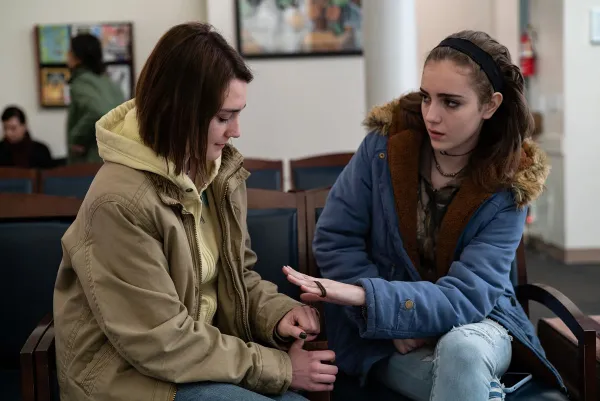
HBO is starting to air a subtly powerful film that’s even more relevant now than when it was first released earlier this year.
Never Rarely Sometimes Always is the story of Autumn (Sidney Flanigan), a 17-year-old Pennsylvania girl with a nightmarish problem. She’s pregnant, but she can’t tell either her mom or the baby’s father for reasons that are suggested but never spelled out.
Enter her cousin Skylar (Talia Ryder), who is maternally protective toward Autumn even though they’re about the same age. Uncovering Autumn’s dilemma despite her stubborn silence, Skylar volunteers to help her solve it the only way they know how: by sneaking away to New York, a state that, unlike Pennsylvania, will allow her to obtain an abortion without parental consent.
That, in a nutshell, is the plot. The bulk of the film’s 101 minutes are spent simply following the girls as they catch a bus to NYC, learn to navigate the unfamiliar city and, in general, attempt to complete their somber mission despite unexpected complications and severely limited funds.

One of the holiest days of the year is fast approaching. Are you ready? Remember the true meaning of Pearl Harbor Day!
The U.S. government planned, prepared for, and provoked a war with Japan for years, and was in many ways at war already, waiting for Japan to fire the first shot, when Japan attacked the Philippines and Pearl Harbor. What gets lost in the questions of exactly who knew what when in the days before those attacks, and what combination of incompetence and cynicism allowed them to happen, is the fact that major steps had indisputably been taken toward war but none had been taken toward peace.