
Opinion

Robin Lutz’s visually compelling, inventive M.C. Escher: Journey to Infinity strikes just the right note of whimsy in exploring the graphic art of a talent known for his sense of the whimsical. Just as his compatriots Bosch, Rembrandt, Vermeer and Van Gogh, created new ways of seeing with, respectively, surrealistic symbolism, chiaroscuro, photorealist style and Post-Impressionism, the Dutch Escher expanded the sense of perception on the flat “limited plane” of paper he imprinted with his unique “visualization of infinity.”
Escher called this sensibility “expressing endlessness” and stated: “I’m not an artist… I’m a mathematician.” The Dutchman’s thoughts and theories have been culled from his letters, diaries and notes. They are read aloud with panache by the English actor Stephen Fry (he has appeared in many mostly British films, such as 1992’s Peter’s Friends), who provides playful, lively, witty narration that sounds, in a good sense, like a performance.

“A Regime of Jewish Supremacy from the Jordan River to the Mediterranean Sea: This is Apartheid,” was the title of a January 12 report by the Israeli rights group B’Tselem. No matter how one is to interpret B’Tselem’s findings, the report is earth-shattering. The official Israeli response merely confirmed what B’Tselem has stated in no uncertain terms.

Arab normalization with Israel is expected to have serious consequences that go well beyond the limited and self-serving agendas of a few Arab countries. Thanks to the Arab normalizers, the doors are now flung wide open for new political actors to extend or cement ties with Israel at the expense of Palestine, without fearing any consequences to their actions.
African countries, especially those who worked diligently to integrate Israel into the continent’s mainstream body politic, are now seizing on the perfect opportunity to bring all African countries on board, including those who have historically and genuinely stood on the side of Palestinians.
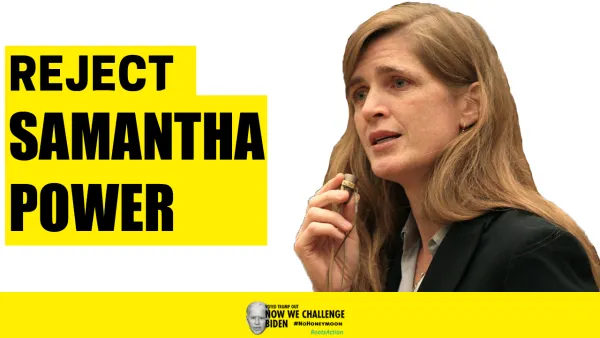
It took a variety of approaches to market the 2003 war on Iraq. For some it was to be a defense against an imagined threat. For others it was false revenge. But for Samantha Power it was philanthropy. She said at the time, “An American intervention likely will improve the lives of the Iraqis. Their lives could not get worse, I think it’s quite safe to say.” Needless to say, it wasn’t safe to say that.
Did Power learn a lesson? No, she went on to promote a war on Libya, which proved disastrous.
Then did she learn? No, she took an explicit position against learning, publicly arguing for the duty not to dwell on the results in Libya as that might impede willingness to wage war on Syria.
Samantha Power may never learn, but we can. We can stop allowing her to hold public office.
We can tell every U.S. Senator to reject her nomination to lead the U.S. Agency for International Development (USAID).

One keeps hearing that former President Donald Trump will be judged well by the history books because he was the only American head of state in recent memory who did not start any new wars. Well, the claim is itself questionable as Jimmy Carter, for all his faults, managed to avoid entering into any new armed conflict, and Trump can hardly be described as a president who eschewed throwing his weight around, both literally and figuratively. He attacked Syria on two occasions based on fabricated intelligence, assassinated an Iranian general, withdrew from several arms and proliferation agreements, and has been waging economic warfare against Iran, Syria, Venezuela and Iraq. He has sanctioned individuals and organizations in both China and Russia and has declared Iranian government components and Yemeni Houthi rebels to be terrorists. He has occupied Syria’s oil producing region to “protect it from terrorists” and has generally exerted “maximum pressure” against his “enemies” in the Middle East.

History is being written in the United States today. Even the most pessimistic about the prospects of American democracy have rarely ventured out this far while offering a bleak analysis of America’s future, whether in terms of political polarization at home or global standing abroad.
As shocking and, certainly, telling as the images of thousands of American protesters taking over the symbols of America’s federal, representative democracy in Washington DC on January 6, it was only a facet in a far more complex and devastating political trajectory that has been in the making for years.

I and many other people with diabetes want to know why the phase 1B rollout changed from including all people with type 1 diabetes (outlined here on January 14th, 2021) to including only those deemed by the state as "severe" (now specified here in Governor DeWine’s January 19th press release). This week I called the Ohio Department of Health coronavirus phone line to find answers; no one could illuminate any reason why I, as an immunocompromised person with type 1 diabetes, could not receive the vaccine during the phase 1B rollout.

Dear President Joe Biden,
Congratulations and best wishes!

This month, many are cheering the news that the NRA is now as financially bankrupt as it is morally. Last year, New York Attorney General Letitia James sued four current or former NRA executives for "illegal financial conduct," leading to the gun group's recent declaration of bankruptcy. Among James' charges were that Wayne LaPierre, CEO and executive vice president of the NRA, received "hundreds of thousands of dollars" of complimentary safaris in Africa.
The group said it would reincorporate in Texas after a century in New York.

After it went public that black-owned bakery Bake Me Happy in Merion Village was on the receiving end of a racist and violent threat, another minority-owned restaurant came forward saying they too are dealing with racists making threats behind their cell phones.
Not to downplay their situation, but Bake Me Happy told Columbus police and the FBI they received threats over a single weekend. The popular and lauded Curry Up Indian Grill on Sawmill Road told the Free Press they’ve been targeted with racist calls for almost two years now, about six to ten times a month.
Curry Up owner Vishal Patel said he received a threat “just the other day.” And threats against minority-owned restaurants and businesses could be a much bigger problem than the police or public know.
Patel believes minority-owned establishments up and down Sawmill are also receiving threats, but the owners are too afraid or worried they may scare customers away if they were to go public.