
Opinion

We don’t see very much in the mainstream media about the situation in Palestine since the ceasefire of the 11-day war last May. In that short war, at least 230 Palestinians were killed, including 65 children and 39 women, with 1,710 people wounded, according to the Gaza Health Ministry. Twelve people were killed in Israel, including a 5-year-old boy and 16-year-old girl.
That the ceasefire is holding is good news. However, the conditions on the ground that led to that conflict continue, like the expulsions of Palestinian families in East Jerusalem, and there are reports of increased violence. According to the October update of United Nations Office for the Coordination of Humanitarian Affairs. Violence continues during the ceasefire, with an additional 100 Palestinians killed in the West Bank and Gaza, and thousands injured. One Israeli was killed since the cease fire. Settler violence has increased, including injury and property damage.
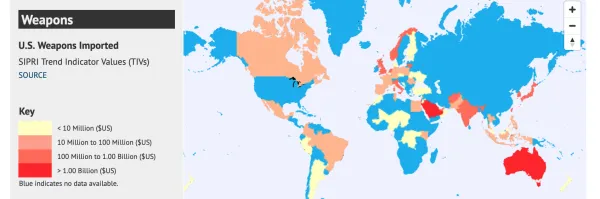
U.S. presidential election campaigns have been known to focus on the slogan “It’s the economy, stupid.”
Efforts to explain the behavior of the U.S. government ought to put a little more focus on a different slogan, found in the headline above.

Ohioans across the political spectrum should appreciate Attorney General Dave Yost for fighting the corruption that has been exposed by the historic HB 6 scandal, but he should go even further. Occasionally in Ohio politics, it’s okay to give credit where credit is due –– Yost’s office has filed a landmark civil racketeering lawsuit against all of the indicted parties (and a few others who are in hot water) which prohibits them from lobbying or holding public office for eight years. “Everyone involved in this sordid matter needs to pay a price,” Yost has said. “The goal is to leave no doubt –– among politicians, the powerful and the rich –– that engaging in public corruption will ruin you."

The fact that two Columbus City Hall insiders, Nick Bankston and Lourdes Barroso de Padilla, pulled petitions to run against three incumbent City Council members, immediately drew a red flag that some type of fix was in the works.
Anyone who follows city politics in Columbus knows that City Hall insiders do not run against City Council incumbents.
Instead, City Council has replaced members who vacate their term early by appointing fellow establishment Dems who, as they did, toe the Columbus Partnership and pro-developer line. A blatant un-democratic and underhanded strategy I have called out since I began running for local office in the 1990s.
Councilmembers Priscilla Tyson and Mitchell Brown, two Democratic incumbents, will be serving out their full term until the end of this year. Council President Shannon Hardin, another City Hall insider who was groomed by former-Mayor Coleman, is seeking re-election. That makes three open seats for City Council and four candidates – besides Hardin, Bankston, and Barroso de Padilla, there’s also Tom Sussi. So only one candidate will lose.

A Rotarian has just made me aware that Rotary quietly adopted a policy in June of not investing in weapons companies. This is worth celebrating and encouraging all other organizations to do likewise. Here is the policy, excerpted from a document pasted below:
“The Rotary Foundation . . . will typically avoid investment in . . . companies that derive significant revenue from producing, distributing, or marketing . . . military weapons systems, cluster munitions, anti-personnel mines, and nuclear explosives.”
Now, I’ll admit that declaring what you will “typically” not do is weak compared to declaring what you will never do, but it does create leverage to make sure that in fact the “typical” behavior is at least mostly what is done.
And it is certainly odd that after “military weapons systems” three particular types of military weapons systems are added, but there doesn’t seem to be any obvious way to read that as excluding other types of military weapons systems. They seem to all be covered.
Below is appendix B from the minutes of a Rotary International board meeting in June 2021. I’ve bolded a bit of it:
*****

The lineup of statewide Democratic candidates remains unsettled.
A few weeks ago, the race for U.S. Senate appeared settled with U.S. Rep. Tim Ryan clearing the field. Then Columbus attorney Morgan Harper entered the fray and Ryan became less than a cinch to gain the nomination.
Democrats can hardly ignore Harper. A progressive Black woman, she took on but lost to U.S. Rep. Joyce Beatty in the 2020 primary for the Columbus-based Congressional seat.
Convention wisdom would suggest that Harper give that race another whirl in 2022, though its boundaries have not been decided. Its makeup as a safe Black seat could be altered by the Ohio Redistricting Commission, the Ohio Legislature or the Ohio Supreme Court as the remap drama continues in Ohio.
More conventional wisdom would suggest that the thirty-something Harper run for a lesser office such as state representative or city council to build her political portfolio.
Instead Harper chose to run for an even higher office, the U.S. Senate, also known as the world's most exclusive club. Ohioans voting a Black women into the club would make double history.
The lineup of statewide Democratic candidates for remains unsettled.
A few weeks ago, the race for U.S. Senate appeared settled with U.S. Rep. Tim Ryan clearing the field. Then Columbus attorney Morgan Harper entered the fray and Ryan became less than a cinch to gain the nomination.
Democrats can hardly ignore Harper. A progressive Black woman, she took on but lost to U.S. Rep. Joyce Beatty in the 2020 primary for the Columbus-based Congressional seat.
Convention wisdom would suggest that Harper give that race another whirl in 2022, though its boundaries have not been decided. Its makeup as a safe Black seat could be altered by the Ohio Redistricting Commission, the Ohio Legislature or the Ohio Supreme Court as the remap drama continues in Ohio.
More conventional wisdom would suggest that the thirty-something Harper run for a lesser office such as state representative or city council to build her political portfolio.
Instead Harper chose to run for an even higher office, the U.S. Senate, also known as the world's most exclusive club. Ohioans voting a Black women into the club would make double history.
The lineup of statewide Democratic candidates for remains unsettled.
A few weeks ago, the race for U.S. Senate appeared settled with U.S. Rep. Tim Ryan clearing the field. Then Columbus attorney Morgan Harper entered the fray and Ryan became less than a cinch to gain the nomination.
Democrats can hardly ignore Harper. A progressive Black woman, she took on but lost to U.S. Rep. Joyce Beatty in the 2020 primary for the Columbus-based Congressional seat.
Convention wisdom would suggest that Harper give that race another whirl in 2022, though its boundaries have not been decided. Its makeup as a safe Black seat could be altered by the Ohio Redistricting Commission, the Ohio Legislature or the Ohio Supreme Court as the remap drama continues in Ohio.
More conventional wisdom would suggest that the thirty-something Harper run for a lesser office such as state representative or city council to build her political portfolio.
Instead Harper chose to run for an even higher office, the U.S. Senate, also known as the world's most exclusive club. Ohioans voting a Black women into the club would make double history.

Several million dollars’ worth of fiction exploded the other day, leaving cinematographer Halyna Hutchins — age 42, a wife, a mom — dead, and plunging Alec Baldwin, who accidentally shot her, into a state of unimaginable hell.
This happened on Oct. 21, in Santa Fe, New Mexico, on the set of the movie Rust. Despite the enormity of coverage the incident has gotten, I remain bewitched with incredulity over one unanswered question. Baldwin, the star of the movie, a Western, and one of its producers, was practicing his gun draw, using a prop gun he’d been given — except the gun wasn’t a prop. It was real. And it was loaded.
My question, of course, is: Why?

This past summer the Ohio Environmental Council (OEC) stated that Issue 7 “is thin on details and short-circuits the city’s ability to mitigate the causes of climate change.”
“Because the city is already moving toward 100% clean energy, the creation of the funds in the ballot initiative is superfluous at best, and outright thievery at worst,” wrote OEC staff attorney Chris Tavenor in an email. “The initiative’s language calls for the transfer of funds into the hands of a privately held corporation, and it further permits that corporation to receive ‘administrative’ fees for the distribution of subsidies. Simply put, a corporation has placed itself in a position to benefit from taxpayer dollars when the city has already created a program in pursuit of similar goals: Clean Energy Columbus. Columbus does not need a private corporation as a financial third party in the pursuit of energy efficiency, clean energy, and electric affordability.”
A recent Dispatch headline offered this scathing condemnation as well, “Weaselly ‘green energy’ group tries to con Columbus voters out of $87 million.”